
Have you ever thought to yourself that there was no possible way you could continue with what you were doing? Have you ever realized that your body's survival instinct was the only thing that kept you going? Physically, motherhood has brought me many of these moments. Childbirth, check. Mastitis, check. (Heaven forbid I ever, ever, ever get that again.) Overwhelming fatigue, check, check, check...
That's pretty much all I can offer right now, besides assorted sadnesses and sorrows that don't belong on a blog. Somehow I know that motherhood has more of those moments in store for me, and not just the physical kind. Everyone has their own trials; braving blizzards in my face for days and burying my family members in unmarked graves on the prairie are probably never going to be mine. But that doesn’t change the fact that they were someone’s.
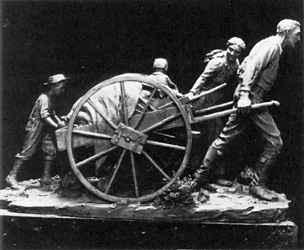
One of my favorite pioneer stories, in a sad and odd way, is that of the Martin and Willie handcart companies, who headed west in late summer of 1856, after many other Latter-day Saints had already settled in Utah and the surrounding area. You’ve probably heard this story, but bear with me because I like the context that Elder Faust puts it in.
I wish to speak this morning to all, but especially to those who feel they have had more trials, sorrows, pricks, and thorns than they can bear and in their adversity are almost drowned in the waters of bitterness. My message is intended as one of hope, strength, and deliverance. I speak of the refiner’s fire.
Some years ago President David O. McKay told from this pulpit of the experience of some of those in the Martin handcart company. Many of these early converts had emigrated from Europe and were too poor to buy oxen or horses and a wagon. They were forced by their poverty to pull handcarts containing all of their belongings across the plains by their own brute strength. President McKay relates an occurrence which took place some years after the heroic exodus: “A teacher, conducting a class, said it was unwise ever to attempt, even to permit them [the Martin handcart company] to come across the plains under such conditions.
“[According to a class member,] some sharp criticism of the Church and its leaders was being indulged in for permitting any company of converts to venture across the plains with no more supplies or protection than a handcart caravan afforded.
“An old man in the corner … sat silent and listened as long as he could stand it, then he arose and said things that no person who heard him will ever forget. His face was white with emotion, yet he spoke calmly, deliberately, but with great earnestness and sincerity.
“In substance [he] said, ‘I ask you to stop this criticism. You are discussing a matter you know nothing about. Cold historic facts mean nothing here, for they give no proper interpretation of the questions involved. Mistake to send the Handcart Company out so late in the season? Yes. But I was in that company and my wife was in it and Sister Nellie Unthank whom you have cited was there, too. We suffered beyond anything you can imagine and many died of exposure and starvation, but did you ever hear a survivor of that company utter a word of criticism? Not one of that company ever apostatized or left the Church, because everyone of us came through with the absolute knowledge that God lives for we became acquainted with him in our extremities.
“ ‘I have pulled my handcart when I was so weak and weary from illness and lack of food that I could hardly put one foot ahead of the other. I have looked ahead and seen a patch of sand or a hill slope and I have said, I can go only that far and there I must give up, for I cannot pull the load through it.’ ” He continues: “ ‘I have gone on to that sand and when I reached it, the cart began pushing me. I have looked back many times to see who was pushing my cart, but my eyes saw no one. I knew then that the angels of God were there.
“ ‘Was I sorry that I chose to come by handcart? No. Neither then nor any minute of my life since. The price we paid to become acquainted with God was a privilege to pay, and I am thankful that I was privileged to come in the Martin Handcart Company.’ ” (Relief Society Magazine, Jan. 1948, p. 8.)
[That speaker was Francis Webster, who was twenty-six years of age when with his wife and infant child he went through that experience. He became a leader in the Church and a leader in the communities of southern Utah. (Gordon B. Hinckley, in Conference Report, Oct. 1991, 77; or Ensign, Nov. 1991, 54)]
Here then is a great truth. In the pain, the agony, and the heroic endeavors of life, we pass through a refiner’s fire, and the insignificant and the unimportant in our lives can melt away like dross and make our faith bright, intact, and strong. In this way the divine image can be mirrored from the soul. It is part of the purging toll exacted of some to become acquainted with God. In the agonies of life, we seem to listen better to the faint, godly whisperings of the Divine Shepherd.
Into every life there come the painful, despairing days of adversity and buffeting. There seems to be a full measure of anguish, sorrow, and often heartbreak for everyone, including those who earnestly seek to do right and be faithful. The thorns that prick, that stick in the flesh, that hurt, often change lives which seem robbed of significance and hope. This change comes about through a refining process which often seems cruel and hard. In this way the soul can become like soft clay in the hands of the Master in building lives of faith, usefulness, beauty, and strength. For some, the refiner’s fire causes a loss of belief and faith in God, but those with eternal perspective understand that such refining is part of the perfection process.
In our extremities, it is possible to become born again, born anew, renewed in heart and spirit. We no longer ride with the flow of the crowd, but instead we enjoy the promise of Isaiah to be renewed in our strength and “mount up with wings as eagles” (Isa. 40:31).
(James E. Faust, in Conference Report, Apr. 1979, 76; or Ensign, May 1979, 53)
I'm grateful for those pioneers, not just because I don't have to walk barefoot across the prairie, but also because I can draw from the strength they exhibited in such a concrete way, and that helps me bear my own burdens.


5 comments:
I remember reading this same story in the Ensign many years ago - and it always moves me.
Thanks for the reminder.
Thanks, Eliza. I've always liked that story, and I've always thought, would I be willing to go through all that to really know God? Hopefully, I'll find some easier way! But that was an inspiring excerpt and what I needed to hear.
This is a great post Eliza. I just gave a talk in sacrament in our new ward and being as it was just the 24th, the topic was pioneers.
I used the Martin and Willie handcart company story in my talk. It is one of those stories that is pretty unbelievable. I read this story by Elder Faust many times during my research and I loved it just as much every time. It's remarkable!
Alison
Personally I can't think of a trial I've been through where during the hardest moments I thought to myself, "This is good for my soul." Nope, normally I'm shrieking, "Why me?" The perspective rarely ever comes until after the pain of the experience has subsided enough for my head to clear a little, or maybe for my heart to soften, or both.
Well said.
Post a Comment